The core hypothesis
Retail has an AI adoption problem, but it is not the one most coverage describes. Adoption is not the bottleneck. By every major published measure, retail leadership has already committed: IBM's Institute for Business Value found 81% of surveyed retail and consumer products executives, and 96% of the teams those executives describe, using AI to a moderate or significant extent. NVIDIA's retail and CPG survey put more than 80% of retail and CPG companies as using or piloting generative AI. Salesforce's Connected Shoppers Report found 75% of 1,700 retail decision makers saying AI agents will be essential to compete.
Then look at the other end of the organisation. UKG, surveying 8,200 frontline employees across 10 countries, found 33% of workers in retail, hospitality and food service currently using AI in their role. That is five points below the 38% all-sector frontline average, and the second lowest of the seven sectors UKG measured. Accenture's 19th Annual Holiday Shopping Survey, in a survey of 100 US retail executives, found that just 5% expect to be fully optimized for generative AI driven customer interactions by 2026.
That is the readiness gap. Not a gap in intent, budget or belief. A gap between what has been bought and what has been absorbed.
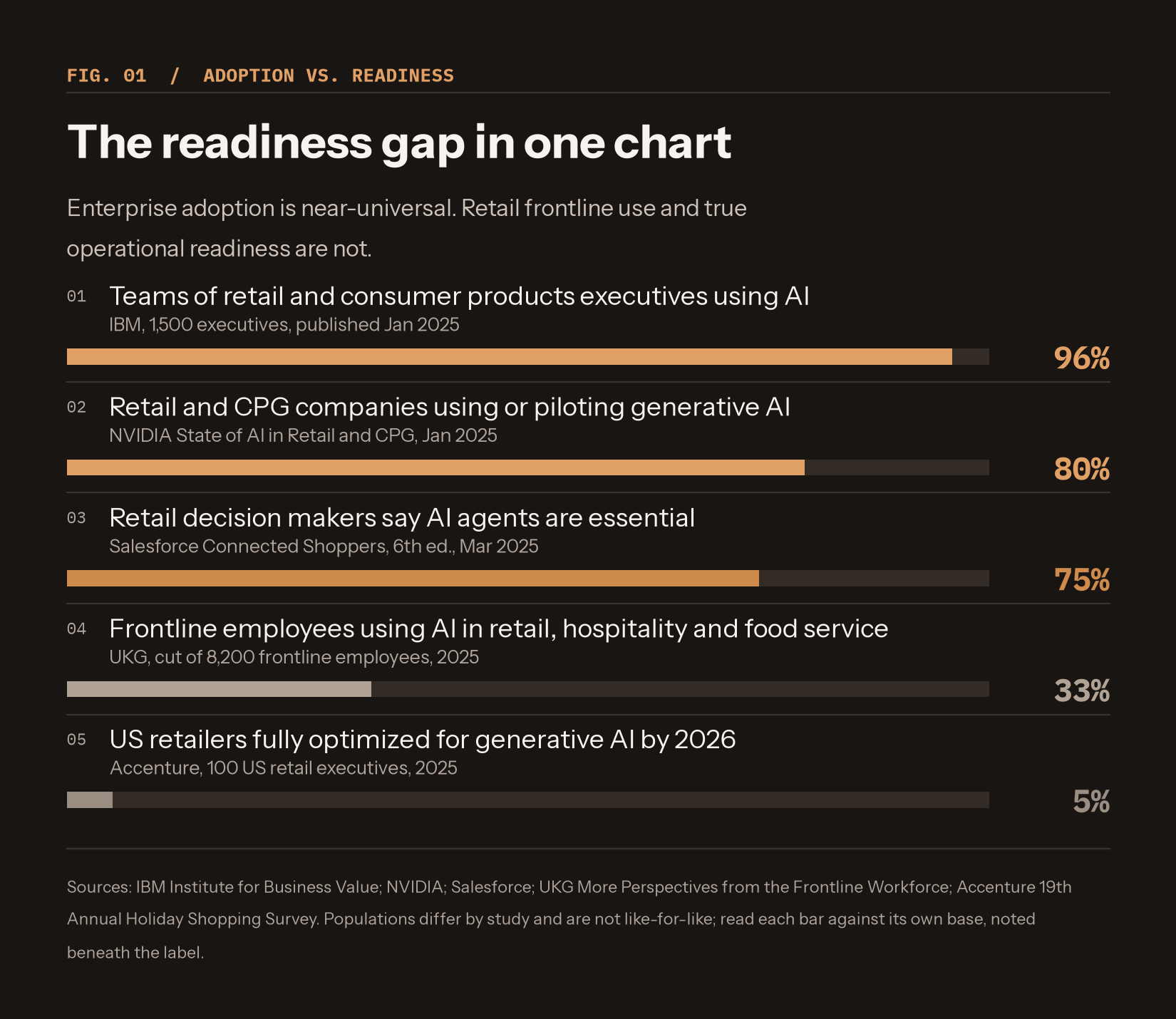
A note on how to read that chart. These are separate readings from separate instruments, not a single measurement. The 96% is executives describing their own teams. The 33% is frontline workers self reporting. Different surveys, different populations, one direction of travel.
Where retail is placing its bets
The published research is far clearer on where retailers intend to apply AI than on where it is actually running at scale. Honeywell, in research fielded by Wakefield among 100 US executives at vice president level or above at retailers with $100 million or more in revenue, found more than 8 in 10 planning to increase automation and AI across operations, though only 35% planned to significantly increase investment.
The distance between those two Honeywell numbers is itself a finding. Most retailers intend to do more with AI. Roughly a third intend to fund it seriously. Intent is cheap, with budget being the tell. Worth noting the fieldwork ran in December 2024 and asked about plans for 2025, so read it as the starting position for the current cycle rather than a 2026 reading.
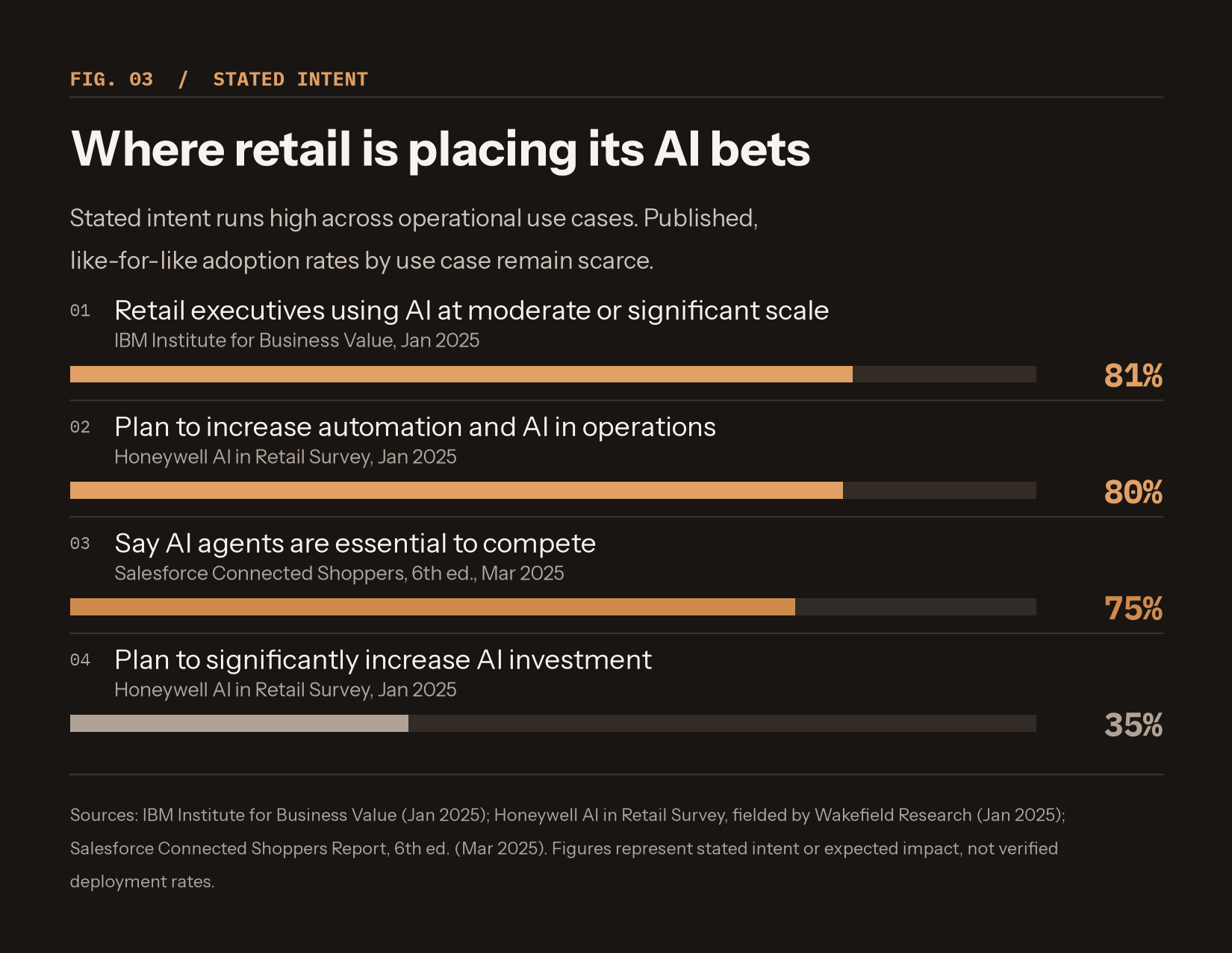
A note on what this chart is not. These are figures for stated intent and expected impact, not verified deployment, and the Honeywell bar plots a stated floor of more than 8 in 10 at 80%. Clean, like for like adoption rates broken out by use case, forecasting against scheduling against service against loss prevention, do not exist in the public record with comparable methodology.
Any report claiming otherwise is stitching together incompatible surveys.
The frontline blind spot
The economic case is not in dispute. McKinsey estimates generative AI could unlock between $240 billion and $390 billion in value across retail, equivalent to a margin increase of 1.2 to 1.9 percentage points across the industry. That range originates in McKinsey's 2023 work on the economic potential of generative AI and is restated for retail in its August 2024 article, so treat it as a standing estimate rather than a fresh 2026 reading.
Margin of that size does not arrive from a head office pilot. It arrives from thousands of stores executing differently, every day. Which means the value depends entirely on the population the research shows is least engaged.
Consider what most retail AI is actually pointed at. Demand forecasting changes what arrives at the store. Workforce scheduling changes when associates work. Loss prevention changes what associates are asked to watch for. Customer service agents change what happens before a shopper reaches the floor. In nearly every case the system is designed at the centre and lands as a change in conditions on the frontline, arriving without much context and often without a route to challenge it.
What the labor data says
The survey research describes intent. Official labor data describes conditions, and in retail the conditions have changed in a way that makes the readiness gap more expensive than it looks.
Bureau of Labor Statistics figures for retail trade show three things happening at once. Average hourly earnings have risen roughly a third since 2019, from a 2019 average of $19.67 to $26.18 across the first seven months of 2026. Employment is essentially flat over the same period, 15.55 million on a 2019 annual average against 15.44 million in July 2026. And the quits rate, which peaked at an annual average of 4.2% in 2021, has fallen to around 2.9% in 2026, modestly below its pre-pandemic average of 3.3% and roughly a third below the 2021 peak.
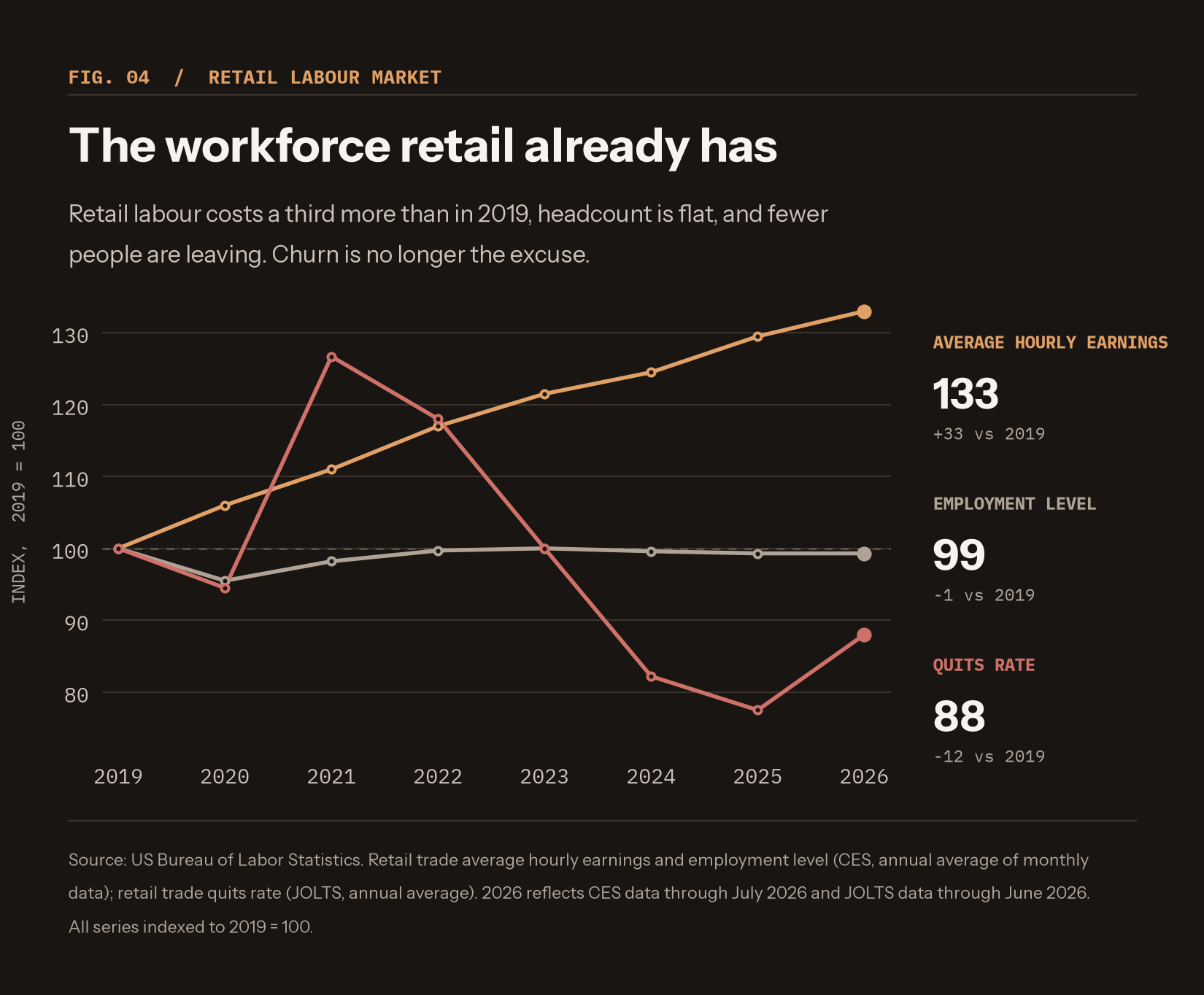
Read that as an operating brief rather than an economic one. Retail is paying a third more for the same number of people, and those people are staying longer than they have in years. The high churn that justified minimal investment in frontline capability is no longer the situation. The workforce a retailer has in 2026 is largely the workforce it will have in 2027.
That reframes AI enablement. Training a workforce that turns over every few months is a leaky investment. Training a stable, more expensive workforce that is already open to AI is a straightforward return calculation, and it is the only route by which head office AI spend reaches the store floor.
The enablement deficit
The industry is not blind to the training question. Epicor's Voice of the Essential Worker found 40% of frontline workers saying their organisation has created programmes to train or upskill workers on AI, 60% saying no training is available to them, and 31% of those who use AI daily doing so without any formal training at all. Deloitte reports that worker access to sanctioned AI tools in consumer companies has roughly doubled in a year, from under 30% to under 60%, while only 25% of those with access use it in daily workflow more than 60% of the time.
What no first tier source publishes is the retail specific version of the question: what share of store associates were trained on the AI their employer actually deployed. Access is now measured. Absorption is not.
That gap in the record matters. The industry measures AI spend, AI pilots, AI use cases and AI expected value with real precision. It measures whether the people who have to use the tools were taught how in far coarser terms, and not at the store level at all. What gets measured gets funded.
Retail can tell you what it spent on AI last quarter. It cannot tell you what share of its store associates were trained to use it.
Trust is not the blocker people assume
The convenient story is that frontline workers resist AI. The data does not support it.
UKG found 43% of frontline employees optimistic about using AI at work and a further 30% undecided, meaning roughly three quarters are open or persuadable. The same research found that frontline workers who use AI report lower burnout than those who do not, 41% against 54%. It also found 76% of frontline employees feeling burned out overall. Those three figures are all-sector toplines rather than retail cuts, so read them as the frontline condition retail sits inside.
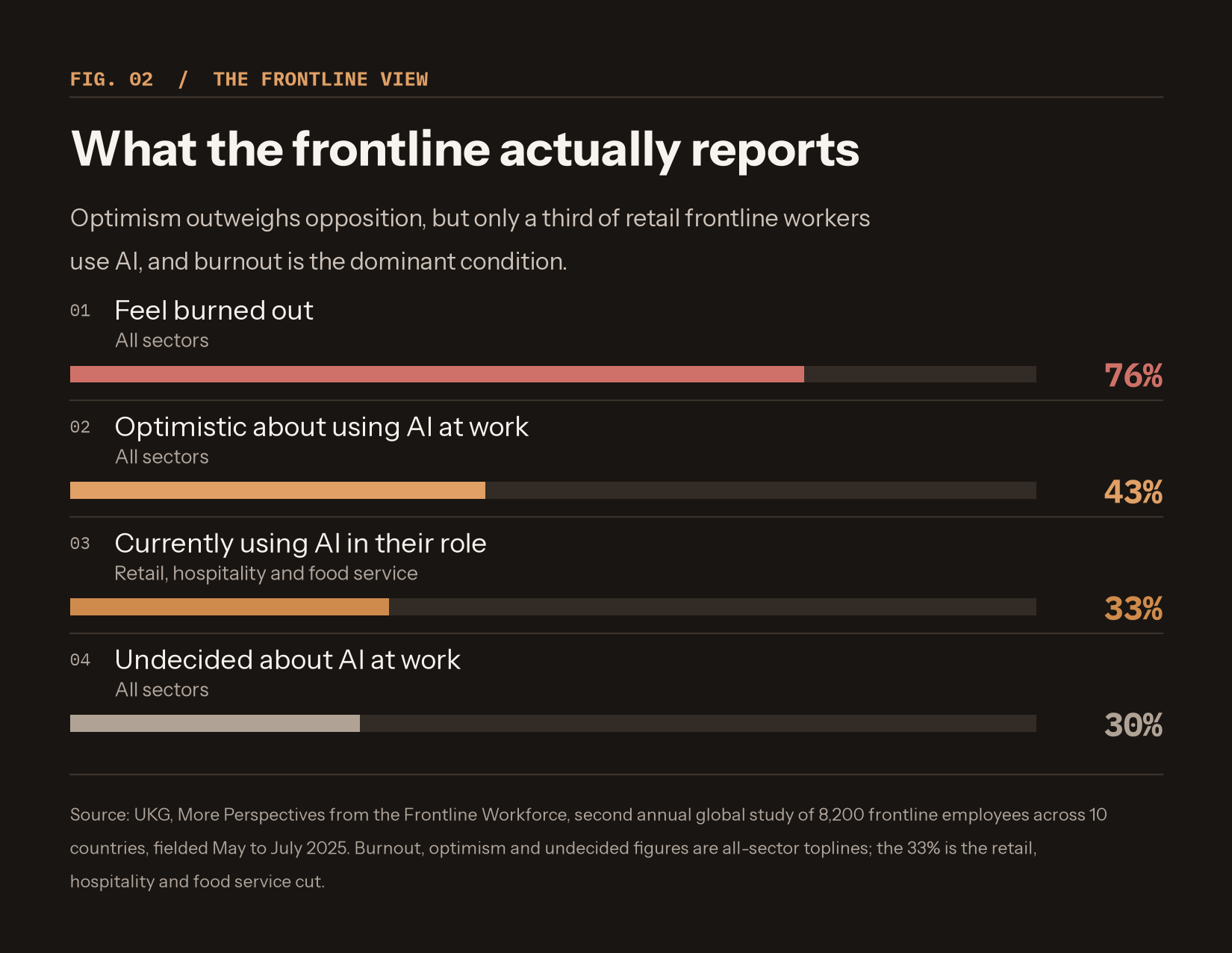
Read those findings together. The frontline is exhausted, largely open to AI, and the people already using it are faring better than those who are not. The constraint is not attitude. It is access, time and training.
What AI readiness in retail actually looks like
Based on the published evidence, readiness in retail is less a technology question than an operating question. Five dimensions separate retailers who will convert AI spend into margin from those who will keep funding pilots.
Access. What proportion of store associates can actually reach an AI tool in the flow of their shift, on a device they already carry.
Enablement. Whether AI training exists as a tracked, budgeted metric rather than an assumption. If you cannot report the number, you do not have the programme.
Design intent. Whether tools were designed with frontline input or handed down from a central function that has never worked a shift.
Time. Whether adoption is expected on top of an existing workload in an environment where 76% of frontline workers already report burnout, or whether something was removed to make room.
Feedback. Whether the frontline has a route to tell the centre that a forecast, a schedule or a prompt is wrong, and whether anyone acts on it.
The 2026 call
Retail does not need to accelerate AI adoption. On the published numbers, adoption at the leadership level is close to saturated. Retail leadership reports near universal AI use in the teams it can see. On the shop floor, a third of frontline workers in retail, hospitality and food service say they use AI at all, the second lowest of any frontline sector UKG measured. Different surveys, different instruments, one direction of travel. Closing that distance is the work.
The retailers that will show AI in their margin line by the end of 2026 are not the ones running the most pilots. They are the ones who can answer a simple question with a real number: what percentage of our store associates were trained on the AI we deployed this year.
Most cannot answer it yet.
Get the monthly Frontline Factor Newsletter
New data reports, frontline trends, and executive briefings — straight to your inbox.