
Store Workers at Walmart Have a New Responsibility: Correcting AI Errors.
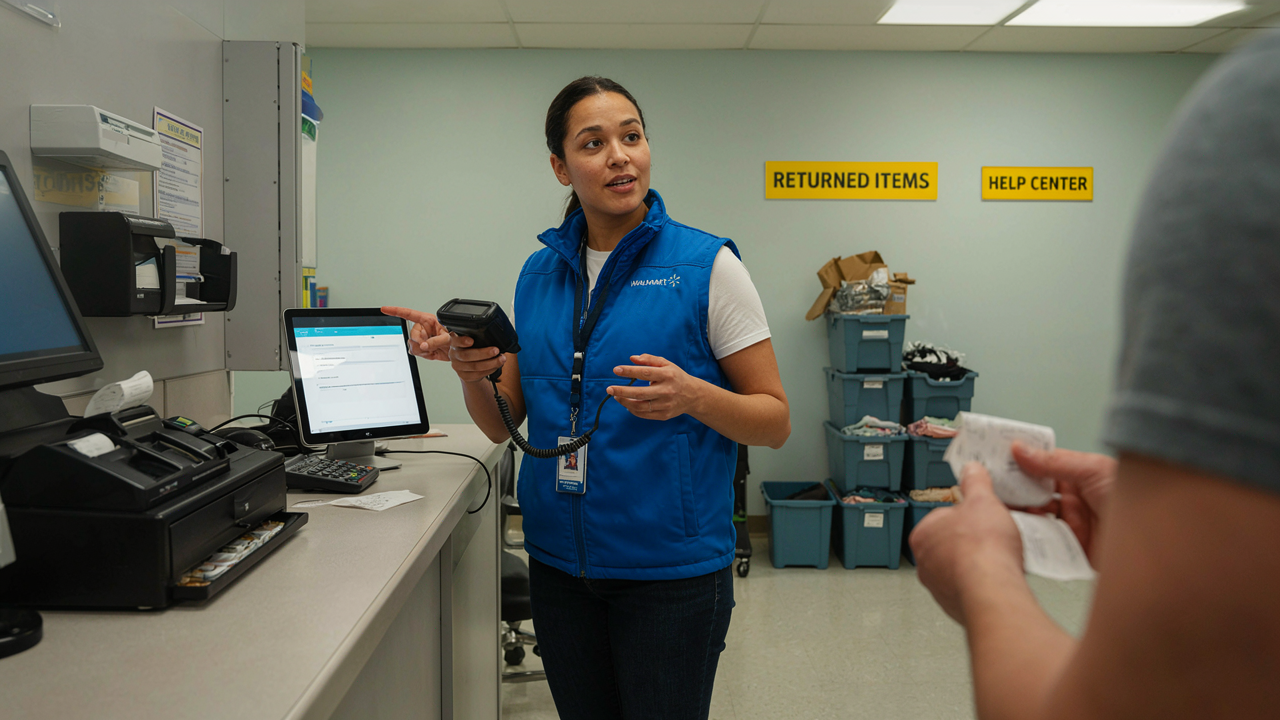

The Frontline Factor — Walmart store workers are now correcting the AI agents that assign their tasks and set timings they can't hit. Managers say they are not enforcing those numbers. That restraint is the only safeguard in the system, and it is not written down anywhere.
Previously covered on The Frontline Factor
What Walmart's Price Tag Shift Means For Digital Frontlines The Shelf Talks Back: What Walmart Associates Are Telling Us On Social Media
(Tuesday, August 25th 2026) -
Store workers at walmart have a new responsibility: correcting AI errors.
This summer, Business Insider reported that Walmart store workers have picked up a new duty: correcting the AI agents that hand them their tasks.
Most coverage focused on workers correcting AI. The real story: software now dictates task times, but no one has settled what those numbers actually mean.
Walmart's own managers are holding the line at AI readiness.
One HR manager told Business Insider the task-assigning agent "just assumes that they're going to be perfect every single time," and that her store is not disciplining people over metrics that don't match the floor. "We're not going to hold people to these impossible standards."
Read that as good management, because it is. Then ask the harder question. If the standard is wrong, and the only thing keeping it from becoming a performance standard is a manager choosing not to enforce it, what exactly is the control?
In The Frontline Factor State of AI Readiness Report, it says that 96% of executives across retail and consumer products have described their team as going all in on AI. That implies a lot of tool using and potential AI upskilling for retail floor associates.
 Data report· 2026The State of AI Readiness in Retail Report 2026Retail is buying AI faster than its frontline can absorb it. The published evidence shows near-universal adoption at the top of the org chart, and a store floor that has barely been brought along.Read the report
Where the tools help
Start with what the tools get right, because dismissing them is lazy. A worker who spends the first fifteen minutes of a shift waiting to be told what to do is being paid to stand still.
Elizabeth Nigh, an asset protection manager in Wisconsin, described the upside to Business Insider on a company-arranged store tour: "If this associate is really good at stocking aisle eight, and we put them in aisle eight all the time, the AI assistant learns that." The payoff is a worker who opens an app instead of waiting around for a plan.
Workers are not uniformly hostile to it either. In a survey of more than 250 Walmart employees this year by the advocacy group United for Respect, roughly 40% said they expect AI could make their job easier, and a similar share said it could strip out menial work.
The appetite is real.
Where the number stops describing the job
The problem is that a task estimate is a claim about reality, and reality on a sales floor is uneven.
The work around the work. Restocking is not putting new merchandise on an empty shelf. It also means checking expiration dates, pulling damaged product, and sanitizing whatever spill nobody reported.
Workers told Business Insider the system often fails to account for those steps, each of which takes a variable amount of time the estimate treats as zero.
The route. An online fulfillment worker said she can't pick general merchandise orders as fast as the app says she should, partly because of the path the AI generates through the store. "It's going to take you all over the place.
There's no way to win on those." Delivery has its own version of this. Spark drivers said a new "smart path" feature sometimes sends them for frozen items at the start of a trip rather than the end.
None of this is an exotic edge case. It is the ordinary texture of frontline work, and it ends the same way every time. Someone did the job correctly and finished late.
Discretion is doing the load-bearing work
Walmart is explicit that the estimates are not a stick. Brooks Forrest, the company's VP for associate tools, told Business Insider in July that stores have autonomy in how they use the tools. "We do not punish people for not following the tech guidance." Workers, he said, "ultimately have the say in what they do."
Take that at face value. It is a clear on-the-record commitment, and more than many employers offer.
It is also a policy, not a mechanism. Thousands of managers interpret it under different pressures, and a manager having a bad quarter interprets differently than one having a good quarter.
When the safeguard against an unrealistic standard is a single person's judgment, the standard is unevenly applied by definition, and nobody above that person can see where it held.
Workers appear to understand the difference. In the same survey, more than 85% said they did not trust the company to prioritize their needs in developing AI, and half named the possibility of AI penalizing them for mistakes.
United for Respect took a shareholder proposal to Walmart's June annual meeting asking for a report on AI's workforce impact. The board opposed it, arguing technology should serve workers by "elevating human capability, improving the customer experience, and making work more meaningful." It did not pass.
The gap doesn't stay a metrics problem
The trust numbers are not the worst of it.
An unmeetable target doesn't sit there being wrong. Either the worker ignores it, which is what one fulfillment worker said she does with irrelevant safety alerts, or the worker finds the time somewhere.
Ava Williams, an overnight stocker in Spokane, told Business Insider that AI-directed workflows push her team to cut corners to keep pace. The steps she named were sanitizing shelves and checking for expired products. "We're expected to meet impossible timelines," she said.
That is a standards gap arriving as an execution failure rather than a morale complaint. What gets sacrificed to an aggressive estimate is almost always the invisible work, which is to say the compliance work.
Last October, Walmart also moved hourly store raises to a performance-rated structure worth up to 5% a year, scored on teamwork, attendance and store performance. AI task times are not among those inputs, which is the right call.
It holds because the company intends it to, not because anything structural keeps the two systems apart. Walls like that erode quietly, usually when someone reasonable decides a completion-rate feed would make ratings more objective.
What separates the AI rollouts that hold up
Name the estimate for what it is. A model's guess at duration belongs in a planning system. If it lands in a worker's app as a countdown, it is a target whatever the policy says.
Make disagreement cheap, and record it. Flagging an estimate as unachievable should generate a data point. If it takes a conversation with a manager, it won't happen at scale, and the correction work everyone is already doing teaches the model nothing.
Write down what the number may never feed. Ratings, raises, scheduling priority, termination decisions. Put the list in the governance doc and give someone the job of defending it against the next reasonable-sounding idea.
Count the correction time as work. Training a model is labor. It comes out of someone's shift, against someone's other targets, and pretending otherwise is how a rollout looks free on paper and expensive on the floor.
The Frontline Take
Every organization pointing AI at frontline work is running a version of the same experiment, and the pattern in this reporting is the familiar one. Ship the estimates, then trust managers to quietly absorb the difference until the model gets good.
That holds right up until it doesn't, and informal restraint leaves no audit trail when it fails.
The leaders who come out of this well will be the ones who wrote the rules while the stakes were still low. Decide now what your task estimates are allowed to touch. If you wait for the first performance conversation that cites a number nobody trusts, the decision has already been made for you.
Key Takeaway
When AI sets the pace, manager discretion is the only thing keeping a bad estimate from becoming a performance standard. Discretion is not a control, and it leaves no audit trail.
Related Articles
Supersize Me, Ronald: McDonald's New Strategy Is Ready. Is the Crew?
McDonald's are reinventing their restaurants globally through their 2026 NEXT growth strategy. The real test is what happens on the crew side. Are the frontline crew ready to adapt?

The Cost of Inconsistency: How Poor Scheduling Drives Up Retail Turnover
Chicago's revised Fair Workweek rules took effect June 1, 2026, and most retailers are reading the news as a compliance map. The costlier question is where schedule instability actually comes from, and how it affects retail turnover.

Returns, Refunds, and Retail Rage. Hold the Frontline.
Returns, refunds, and rage. From January 2027, large New York retailers must install silent response buttons. The law handles the incident. It does nothing about the slow version, the ordinary Tuesday that quietly returns a different person to their family.