Key retail workforce benchmarks
The core hypothesis
Retailers spent years optimizing labor efficiency through lean staffing models, tighter scheduling, and operational precision. But the benchmark data suggests many retailers may now be operating with too little workforce stability to absorb disruption consistently.
The 60% turnover problem
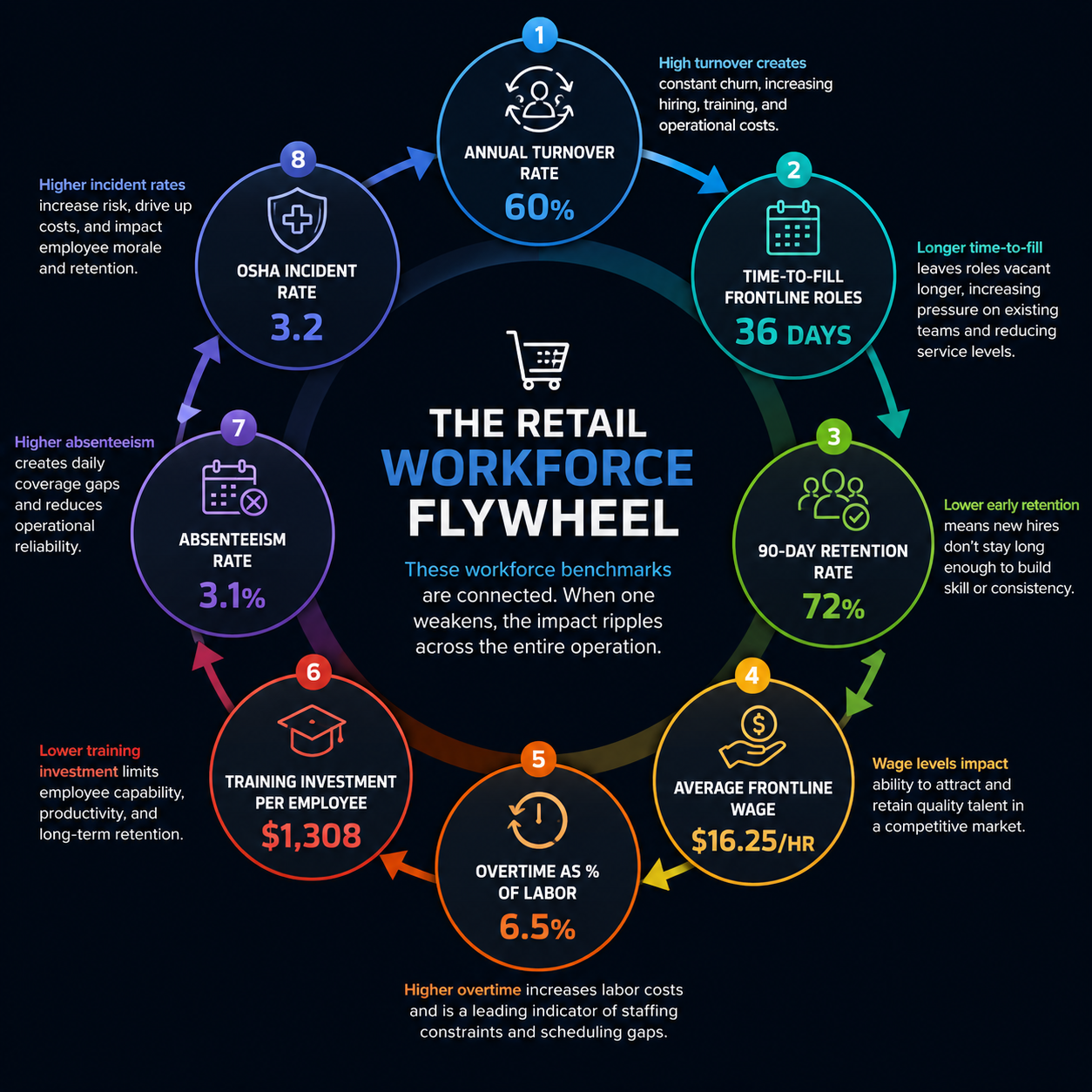
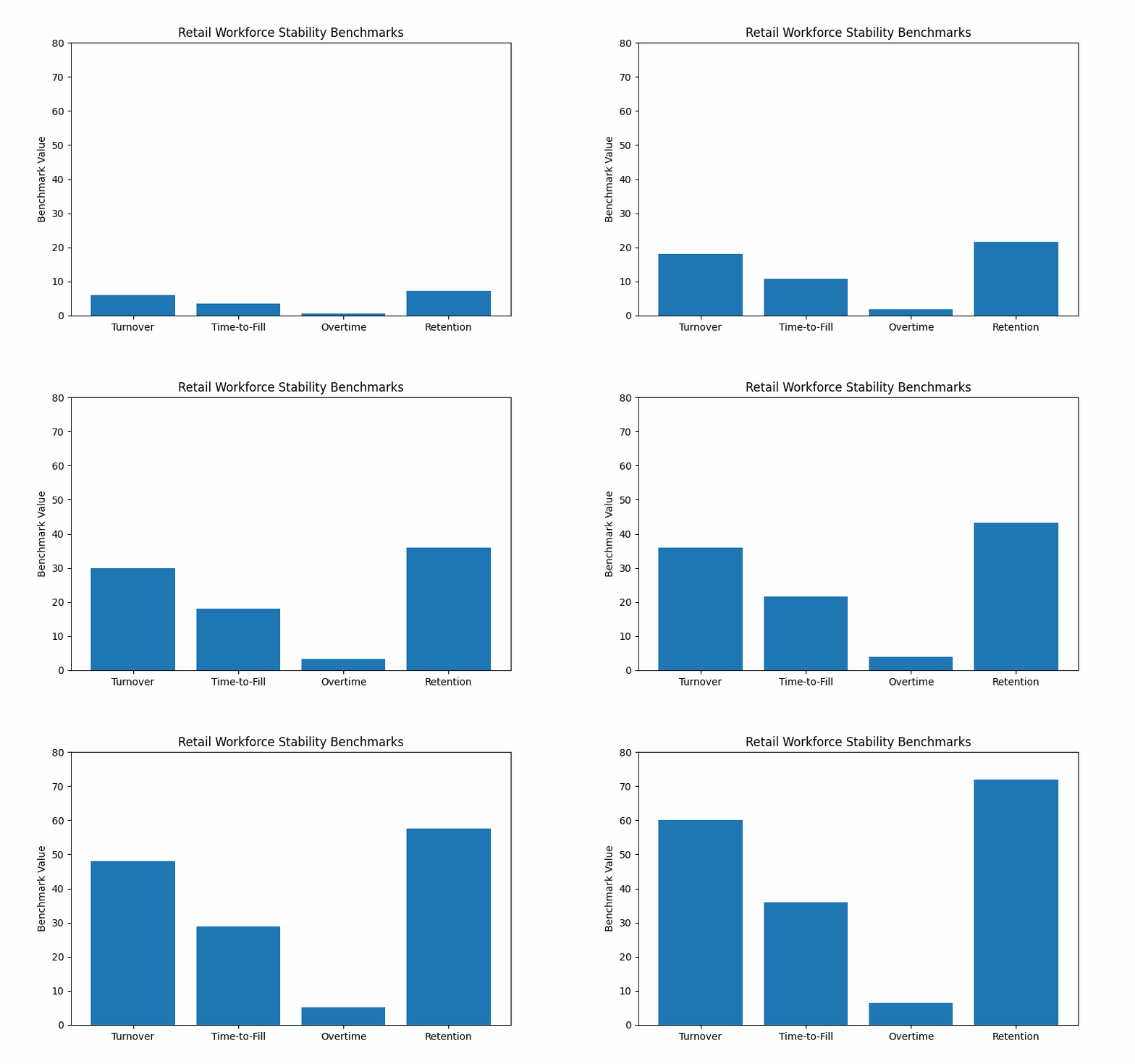
Retail benchmark medians show annual turnover rates sitting around 60%, highlighting how workforce churn remains structurally elevated across the sector. High turnover impacts stores operationally long before it appears financially.
When experienced associates leave, stores lose product knowledge, floor familiarity, customer continuity, and operational consistency simultaneously.
Operational impact:
- Increased onboarding burden
- Slower customer assistance
- Reduced merchandising consistency
- Greater workload pressure on remaining employees
Why 36-Day hiring cycles matter
Retail benchmark medians show frontline hiring cycles averaging 36 days. In modern retail operations, that is a long period for stores to remain understaffed.
Retail stores increasingly function as fulfillment hubs, pickup centers, returns processors, and customer service environments simultaneously. Extended hiring cycles create operational gaps that ripple directly into execution quality.
The result is often:
- Higher overtime reliance
- Schedule compression
- Store manager burnout
- Lower customer experience consistency
The Overtime-Stability loop
Retail overtime medians currently sit at 6.5% of total labor. While overtime can temporarily stabilize staffing shortages, sustained overtime often accelerates fatigue and workforce instability over time.
In many stores, overtime becomes a symptom of broader staffing fragility rather than simply a labor allocation strategy.
Retailers operating with consistently elevated overtime often face:
- Higher absenteeism
- Greater scheduling friction
- Reduced associate engagement
- Higher risk of turnover acceleration
The training investment gap
Retail benchmark medians show training investment averaging roughly $1,308 per employee. But operational complexity inside stores has increased dramatically.
Today’s retail associates increasingly navigate:
- Omnichannel fulfillment systems
- Mobile inventory tools
- Digital checkout workflows
- Returns logistics
- Customer escalation handling
Many retailers may still be training frontline employees for yesterday’s operating model while asking them to execute inside a much more operationally demanding environment.
Why workforce stability is becoming a customer experience issue
Retail workforce instability no longer stays hidden in HR metrics. Customers increasingly experience its effects directly through execution inconsistency.
Understaffed or unstable stores often struggle with:
- Longer checkout times
- Slower pickup fulfillment
- Reduced floor coverage
- Poor recovery standards
- Inconsistent customer assistance
The more retail operations compress labor flexibility, the less margin stores have to absorb disruption without affecting execution quality.
The emerging retail divide
The retailers likely to outperform over the next decade may not simply be the organizations with the leanest labor models.
They may instead be the retailers capable of maintaining workforce stability while operational complexity continues rising.
That includes the ability to:
- Reduce unnecessary churn
- Support store managers
- Stabilize onboarding
- Improve workforce adaptability
- Maintain execution consistency during disruption
Get the monthly Frontline Factor Newsletter
New data reports, frontline trends, and executive briefings — straight to your inbox.