
How to Conduct Retail Stay Interviews That Actually Prevent Turnover


The Frontline Factor — The seasonal churn in retail is a predictable, yet often painful, reality. Retail stay interviews conducted right, can be the balm.
The seasonal churn in retail is a predictable, yet often painful, reality.
But it doesn't have to be.
For every experienced associate walking out the door, there's a significant cost in recruitment, training, and lost productivity. Some estimates place the cost of replacing an employee at one-half to two times their annual salary.
What if you could anticipate these departures and address concerns before an employee decides to leave, especially during the crucial holiday rush or back-to-school season? Proactive, structured stay interviews are a powerful tool for retail leaders to identify and mitigate employee dissatisfaction, fostering a more engaged workforce and significantly reducing costly turnover during high-stakes operational periods.
Understanding the "Why" behind stay interviews in retail
Stay interviews are focused conversations with current employees to understand what makes them stay with your company, what might cause them to leave, and what improvements could be made to their experience. Unlike exit interviews, which gather data after an employee has already decided to depart, stay interviews provide real-time insights that allow for intervention and retention strategies, a distinction highlighted in HR best practices guides.
On a fast-paced shop floor, where front-line employees are the direct line with customers, employee satisfaction directly impacts sales, customer loyalty, and brand reputation. From a leadership perspective, meeting employees where they are, ideally before the stay interview itself, is essential.
Addressing high turnover in retail
High turnover disrupts team cohesion, burdens remaining staff, and degrades the customer experience, as consistently shown in workforce management studies. Stay interviews act as an early warning system, helping managers identify potential flight risks and underlying dissatisfaction before they escalate to a resignation. They also allow for targeted retention efforts by pinpointing specific challenges unique to your store or department, so solutions can be genuinely tailored rather than generic.
Beyond damage control, there's a cultural upside: employees feel valued when their opinions are actively sought and acted upon, which lifts morale and engagement across the team. The insights gathered can also lead to systemic improvements in management practices, scheduling, training, and compensation. Perhaps most critically for retail, addressing concerns proactively protects your operation during peak seasons, ensuring you're not losing key people just when you need them most.
Sometimes, despite best efforts, team members will still decide to leave. In HR leadership, it's your job to figure out what went wrong and whether there's an opportunity to fix it.
Preparing for effective retail stay interviews
Preparation is paramount to conducting successful stay interviews. This isn't just another performance review. It requires a specific mindset and structure.
Manager training and mindset
Retail managers, often juggling multiple tasks, need to understand the distinct purpose of stay interviews. The goal is to gather information and build trust, not to fix everything immediately.
Not every issue can be resolved on the spot, but acknowledging concerns is crucial. Managers should approach these conversations with a non-judgmental stance, encouraging open and honest sharing without defensiveness or debate, and assure employees that their feedback will be used to improve the workplace, not to penalize them.
While complete anonymity is difficult in a one-on-one setting, individual responses should be aggregated or anonymized when sharing broader trends.
Practically speaking, managers also need to be able to translate feedback into actionable items they can influence, or escalate appropriately when something falls outside their control.
Developing interview questions
Craft a core set of open-ended questions that encourage detailed responses rather than simple yes or no answers. The following can serve as a starting point:
- What do you look forward to when you come to work each day?
- What do you like most about your job here at [Store Name]?
- What are you learning here, and what more would you like to learn?
- Do you feel you receive sufficient recognition for your contributions? If not, what kind would be most meaningful to you?
- What might cause you to leave? What would your dream job look like, and why?
- If you could change one thing about working here, what would it be?
Scheduling and logistics
Integrate stay interviews into your operational calendar strategically. Conduct them well in advance of peak seasons, such as late summer ahead of the holidays or early spring before summer, so there's time to act on what you learn. Schedule during quieter periods or off the sales floor, in a private setting with minimal interruptions. This signals genuine respect for the employee's time and input. For larger teams, a phased rollout may be necessary to accommodate diverse shifts and availability. Before interviews begin, communicate clearly with the whole team: what stay interviews are, why you're doing them, and what employees can expect.
Conducting the stay interview: a Step-by-Step guide
The interview itself is a delicate balance of active listening and empathetic dialogue.
Step 1: set the stage (2–3 minutes)
Open by reiterating the purpose and setting expectations. Thank the employee for their time, clarify that this is not a performance review, and emphasize that feedback will be used to improve the workplace for everyone. Reinforce confidentiality by explaining that individual responses will be summarized into broader trends, not attributed, and confirm the conversation will take roughly 20 to 30 minutes.
Step 2: ask the questions and actively listen (15–20 minutes)
Work through your prepared questions naturally rather than rigidly. The most important thing here is to listen more than you talk. Allow silence, don't interrupt, and probe for detail when an employee gives a short answer. "Can you tell me more about that?" goes a long way. Pay attention to non-verbal cues and take notes on key phrases, capturing enough to recall the essence of their feedback without transcribing every word. If an employee shares a critique, resist the urge to explain or justify. "I hear what you're saying" is far more effective than "Well, the reason for that is..."
Step 3: identify actionable insights (3–5 minutes)
Before wrapping up, summarize what you've heard: "So, to recap, what I'm hearing is that you really value X, but you're concerned about Y, and you'd like to see more Z." Then focus on what's actionable. Out of everything shared, what one or two things could you or the store realistically influence? Where appropriate, collaborate: "What do you think would be a good first step to address that?"
Step 4: thank and follow up (2 minutes)
Close on a positive, empowering note. Express genuine gratitude for the employee's honesty and explain what happens next: that you'll be gathering themes across the team and developing action plans, with findings shared in the coming weeks. Leave the door open so the conversation doesn't feel like a one-time exercise.
Acting on feedback and sustaining the program
The true power of stay interviews lies not just in conducting them, but in what you do with the information afterward.
Analysis and action planning
Once interviews are complete, look for patterns across the feedback. Group similar comments into categories such as scheduling flexibility, training needs, recognition, or communication with management, then prioritize by frequency, impact, and feasibility. From there, develop specific, measurable action plans with clear ownership and deadlines. Vague intentions don't move the needle; concrete steps do.
Communicating with the team
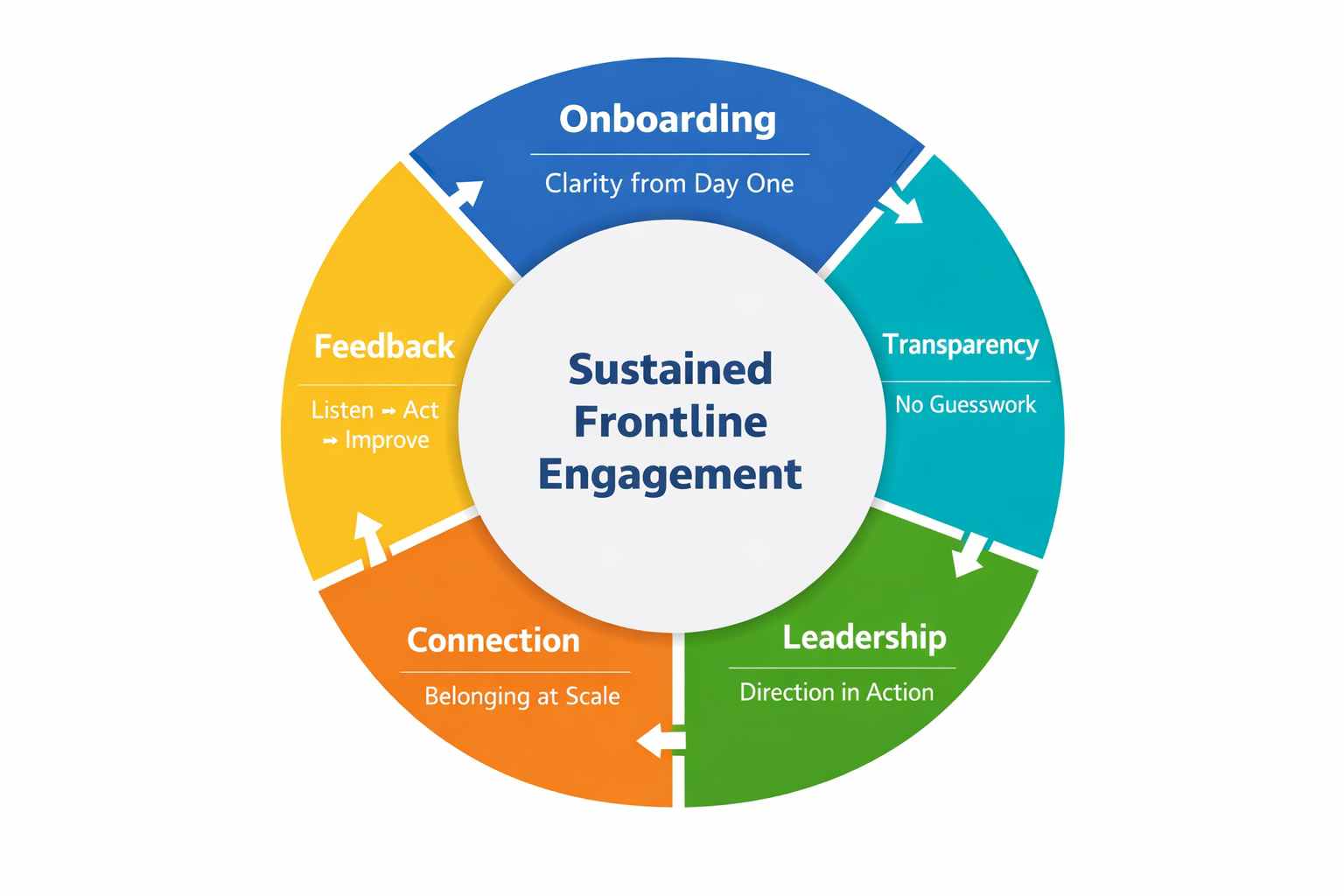
Transparency is vital for building trust and demonstrating that feedback is taken seriously. Share aggregated themes with the broader team without singling out individuals. Communicate the action plans you're putting in place and the reasoning behind them, and keep the team updated as changes are implemented. Nothing reinforces a culture of openness more than employees seeing their input translate into real change.
Continuous improvement
Stay interviews shouldn't be a one-off event. Conduct them annually or semi-annually, with lighter check-ins before critical periods like the holiday season. Ensure all retail managers are trained to lead these conversations effectively, and track turnover rates, engagement scores, and customer satisfaction over time to measure impact. Revisit and refine your questions as you learn, since new challenges will surface and your interview framework should evolve with them.
The Frontline Take
Every employee is a brand ambassador and every shift contributes to the bottom line, so proactive retention isn't just good practice. It's an operational necessity.
Retail stay interviews, when executed thoughtfully and consistently, offer a distinct strategic advantage. They transform the often-passive act of employee relations into an active, data-driven approach to retention, shifting the focus from reacting to departures to proactively cultivating an environment where employees feel heard, valued, and empowered to stay.
Key Takeaway
The seasonal churn in retail is a predictable, yet often painful, reality. Retail stay interviews conducted right, can be the balm.
Related Articles

Corporate Culls Versus the Frontline Crisis: Why You Can’t Cut Your Way to Retention
Recent headlines paint a stark picture: corporate giants like eBay are implementing significant layoffs, culling hundreds, sometimes thousands. How does this affect frontline resilience and employee retention?

Making it to the Playoffs: Seasonal Retail Tryouts Begin.
Retailers are expected to add about 450,000 seasonal workers this quarter, and most big names aren't announcing targets. A smaller, more surgical intake changes what each holiday hire is for, and who should be watching.

The Cost of Inconsistency: How Poor Scheduling Drives Up Retail Turnover
Chicago's revised Fair Workweek rules took effect June 1, 2026, and most retailers are reading the news as a compliance map. The costlier question is where schedule instability actually comes from, and how it affects retail turnover.