
Why Your $10m Automation Investment is Failing: The Frontline Competency Gap


The Frontline Factor — Manufacturing leaders are investing millions in automation and wondering why the returns aren't materializing. Learn why the problem usually isn't the technology.
Your $10 million automated guided vehicle system is sitting idle again. Why?
Not because it's defective. Not because the vendor oversold it. Because the operator on the floor can't interpret the diagnostic reading, and the technician who can is three hours away.
That's the frontline competency gap.
And it's costing manufacturers more than most operations teams realize, because it never shows up as a single line item.
A recent Gartner study of over 3,100 CIOs and technology executives found that only 48% of digital initiatives meet or exceed their business outcome targets. For manufacturers, the culprit is rarely the technology itself. It's the assumption that technology succeeds on its own terms, without the human infrastructure to support it.
Experienced operators and technicians are retiring faster than they can be replaced, taking decades of institutional knowledge with them, while newer hires are entering a far more complex, software-driven production environment that demands a different skill set from day one.
At the same time, automation adoption is accelerating, not slowing, which compresses the window to get workers up to speed. The result is a widening gap between the sophistication of the technology on the floor and the readiness of the people expected to run it, turning what used to be a gradual training challenge into a real-time operational risk.
Your automation investment is only as strong as the workforce operating it. Without deliberate upskilling built into the rollout, sophisticated machinery becomes an expensive monument to unrealized potential.
The investment case looks airtight until it isn't
The pitch is always compelling. Competitors are streamlining.
Consultants model the ROI on ideal operating scenarios. Equipment is ordered, the floor is redesigned, installation begins. But what those models don't account for is that modern manufacturing equipment is not plug-and-play.
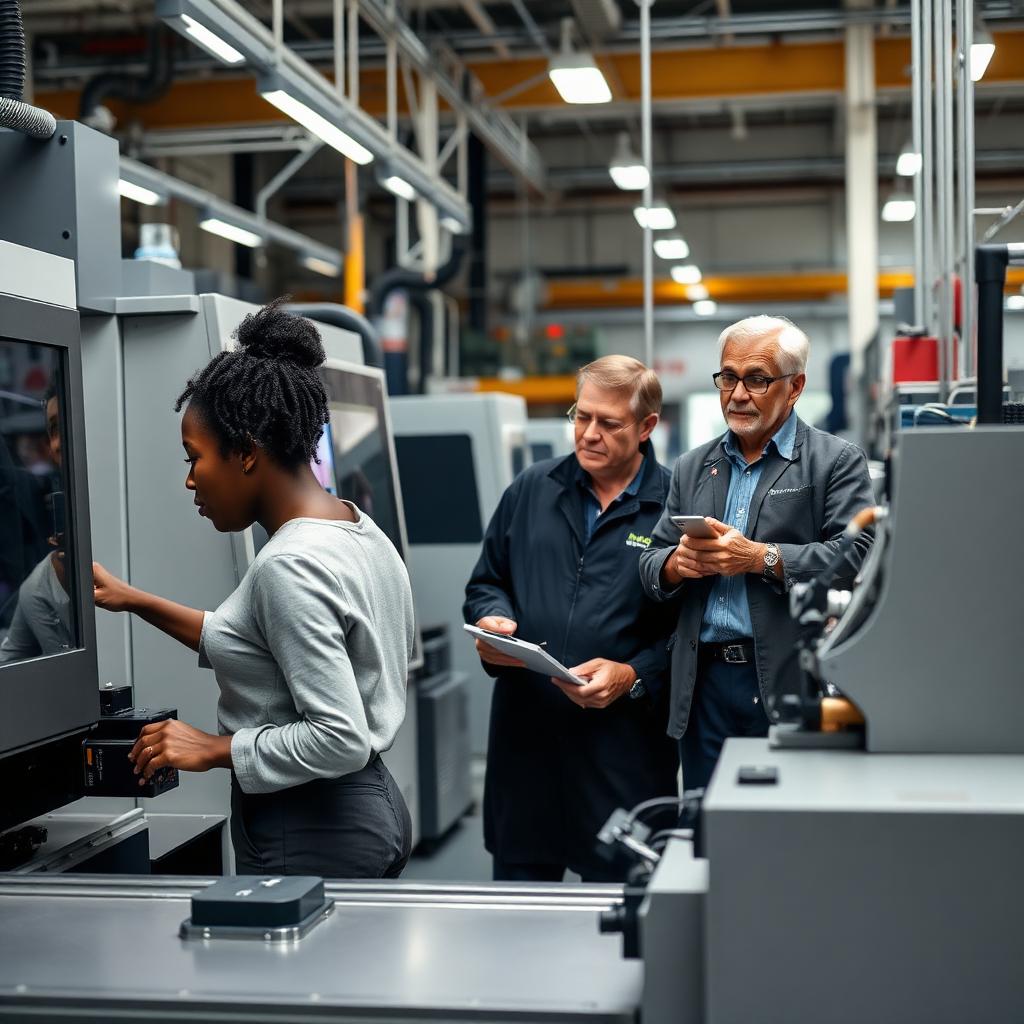
It requires operators who can troubleshoot complex systems, technicians who run preventative maintenance on intricate robotics, and floor supervisors who understand how automated processes connect to the broader production flow.
When that human layer isn't ready, the technology underperforms. Not dramatically. It just never reaches what it was supposed to be. The $10M AI supply chain system runs at 40% of capacity indefinitely, exhausting time, patience and margins.
What the competency gap actually costs you
Asset underutilization. Advanced equipment ships with capabilities most operators never touch. Features go unused, settings go uncalibrated, analytical outputs go unread. You paid for a high-performance system and you're running a fraction of it.
Downtime and maintenance bleed. Untrained operators mishandle equipment. Minor issues become major ones. Repair cycles stretch. External support costs climb. Spare parts get ordered on wrong diagnoses.
Quality erosion. Automation is supposed to improve consistency. When operators can't read diagnostic outputs or adjust settings correctly, variation creeps back in, and with it, rework, scrap, and warranty exposure.
Turnover acceleration. Employees who feel consistently out of their depth don't stay. They leave, taking whatever institutional knowledge they did acquire with them, and the gap widens.
Closing the gap: what it actually takes
Bridging the competency gap isn't an HR initiative tacked onto the back end of a rollout. It's a prerequisite, and it starts before the equipment arrives.
Do this:
Run a skills audit before procurement. Map what the new technology requires. Inventory what your workforce currently has.
That gap between the two is your training roadmap. It should inform your implementation timeline, not follow it.
Make training part of the purchase agreement. Equipment suppliers should provide hands-on, role-specific training as a contract deliverable, not a PDF manual.
Demand it. Negotiate on-site support during the first operational phase.
Build a tiered program. Not everyone needs the same training.
Operators need safe startup, basic controls, and emergency procedures. Advanced operators need diagnostics and optimization.
Technicians need preventative maintenance and software-level troubleshooting. Supervisors need data interpretation and process integration. Each role has a different job to do with the technology; the training should reflect that.
Use the tools that exist for this. VR simulation lets operators practice on complex machinery before they touch the real thing.
Microlearning modules put refresher content on their phones for on-demand use. Both compress time-to-competency in ways traditional classroom training doesn't.
Bring frontline workers in early. Operators who participate in implementation design produce better interfaces, better layouts, and fewer adoption problems.
They are the connective tissue between your capital investment and your output. Treat them accordingly.
The Frontline Take
The manufacturers getting a measured return on their automation investments aren't necessarily the ones with the most advanced equipment. They're the ones who treated workforce readiness as part of the capital plan from the start, not something to sort out after the machine arrived.
Key Takeaway
In an era defined by rapid technological advancement, many manufacturing leaders are pouring capital into AI-driven robotics, automated assembly lines without upskilling. Keep ROI and retention high by investing in your frontline teams training.
Related Articles

Do it Yourself, Frontline: Why AI Self-service is the Future of HR Support
Manufacturers in 2026 are increasingly adopting AI-self-service chatbots to help with routine HR queries. Is this a good thing, and how do leaders embrace this shift while keeping the human in HR?

Industrial Robots Are Reaching Record Sales, But No One Knows How To Run Them. That's a Big Problem.
The simple truth is that a robot, no matter how advanced, is only as good as the humans who support it. Neglecting this crucial human element transforms a strategic asset into a significant operational vulnerability.
Machines Aren’t the Constraint, the Manufacturing Labor Shortage Is.
U.S. manufacturing output is experiencing a boom in the early part of 2026, with the Purchasing Managers' Index (PMI) consistently signaling growth and new orders on the rise. But will shortages in labor block this growth?