
Healthcare Staffing Algorithms: Promise Versus Reality for Shift Managers


The Frontline Factor — In healthcare, every minute counts, so it can be tempting to fully rely on an AI algorithm to give your health team all the answers, but one thing AI still can't do is fully account for human nuance and context.
Earlier this year, nurses at Munson Medical Center in Traverse City, Michigan, rallied for a contract that, alongside the usual fights over pay and staffing levels, demanded oversight of how AI tools get deployed in their hospital.
Their union president drew the line in one sentence: technology is coming, and they want it to be good for them and their patients, but it cannot be allowed to replace nursing judgment. A New York City nurses' union of more than 10,000 members won similar AI protections over the winter. The nurses are not refusing the technology. They are refusing to be cut out of decisions about it.
That fight is happening because the technology is arriving fast. AI staffing tools are now sold on the promise of handling the whole scheduling puzzle. Balance nurse-to-patient ratios, match skills to acuity, honor shift preferences, stay inside labor law, and forecast demand from historical data.
For a hospital system running thousands of employees across dozens of units, the pitch lands hard. Labor is one of the biggest costs a health system carries, and the manual version of this work burns hours of manager time and still produces schedules nobody loves.
So the appeal is real. The question worth asking is narrower than the vendors frame it: what actually happens when that optimized schedule meets a Tuesday on the floor. The nurses bargaining over it have already named the thing that decides the answer. Whether the tool replaces their judgment or supports it is the whole ballgame, and most rollouts get it backward.
What AI scheduling gets right
There is a genuine case for these systems, and it is worth stating plainly before picking it apart.
Overtime is the easiest target. When demand is predicted with any accuracy and shifts are distributed fairly, the expensive last-minute coverage that eats labor budgets starts to shrink. Compliance is another. Labor laws, union agreements, and certification rules are exactly the kind of rigid, high-volume logic software handles better than a tired manager at 11 p.m. And there is a staff-retention argument: schedules that respect stated preferences and spread the bad shifts evenly tend to keep people longer than schedules that don't.
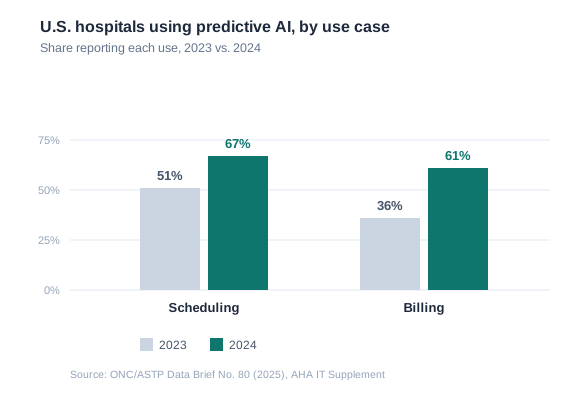
The shift is already showing up in federal data. In a national survey released in late 2025 by the Office of the Assistant Secretary for Technology Policy, the share of U.S. hospitals using predictive AI to facilitate scheduling climbed from 51 percent in 2023 to 67 percent in 2024, one of its two fastest-growing uses alongside automated billing. That number tells you where the budget is moving. It does not tell you whether the tools are working once they are installed.
Where it breaks
The gap between a clean schedule and a working one usually opens in three places.
The data is messier than the model assumes. An algorithm is only as good as what you feed it, and healthcare data is famously fragmented. If a nurse's skill profile is six months out of date, the engine will confidently assign them to a case they are no longer cleared for. If preferences were entered at onboarding and never touched again, staff watch the system ignore requests they made last week and conclude, correctly, that it isn't listening.
Worst of all, the model is trained on history. A sudden patient surge, a cluster of call-outs, or a piece of equipment going down doesn't appear in last year's averages.
The model can't see the part of the job that matters most. A schedule built Sunday night can be obsolete by Monday morning when the ER floods or a critical patient needs one-on-one care. Beyond that, experienced managers carry knowledge that was never written down anywhere a system could read it. They know which two people work well together during a complex procedure and which pairing quietly falls apart under pressure. They know who is running on fumes this week and shouldn't get the hard assignment, even though the numbers say they're available.
That last call isn't a math problem. It's judgment about human limits, and a purely data-driven system will optimize right past it.
The tool gets handed down, not built with. New systems meet resistance everywhere, but it bites harder when staff read the tool as a verdict on their manager's expertise. The deeper root is the one the Michigan and New York contract fights keep surfacing. As Columbia nursing professor Max Topaz put it, the technology is frequently just handed to nurses, who had no part in designing it or deciding how it would fit into the way they actually work.
When the logic is a black box, nobody trusts the output, because nobody can see why the schedule came out the way it did. And the relief is rarely immediate: in the early months, managers can end up spending more time, not less, correcting bad data and overriding assignments the system should have gotten right. A tool sold as relief that starts its life as extra work has a credibility problem before it has earned anything.
What separates the systems that stick
The organizations that get value out of these tools share a pattern. They treat the algorithm as a recommendation engine the manager runs, not a dispatcher that runs the manager. A few things follow from that.
Start in one unit, not across the network. Pick a unit with engaged leadership and staff who are open to it, give them a real channel to report what's broken, and use what comes back to tune the parameters and fix the data pipelines before you scale. A bad first impression in a 5,000-person rollout is expensive to undo.
Fix the data before you trust the output. Standardize how skills, certifications, and availability get entered, and wire the scheduling system to the HR database so training and credential changes flow in automatically instead of waiting on a manual update that never comes. Audit it on a schedule. Clean inputs are not glamorous, but they are the difference between a tool managers defend and one they route around.
Make the logic visible. Managers don't need to trust a black box; they need to see why a schedule was generated, which factors the system weighed, and where they sit. That means training that goes past which buttons to click and explains what the engine is actually optimizing for. A manager who understands the logic can correct it intelligently. One who doesn't will either rubber-stamp it or ignore it, and both are failures.
Build the override in on purpose, and learn from it. The manager has to be able to change the schedule when real-time judgment says so, easily, without filing a ticket. The smarter move is to capture why each override happened and feed it back into the model. Every correction is a piece of the tacit knowledge the system was missing. A tool that learns from its overrides gets better. One that fights them stays brittle.
Measure something other than cost.
If the only scoreboard is dollars saved, the tool will optimize for the wrong thing and you won't notice until your best people leave.
Track perceived fairness and morale. Watch whether optimal staffing actually moves patient-safety and readmission numbers. Check whether managers are genuinely spending less time on the schedule and more time on their teams. Cost savings that come at the expense of the people delivering care are not savings. They are deferred turnover.
The Frontline Take
The test of one of these systems was never its output on paper. It is what happens at 7 a.m. on a short-staffed floor when the schedule and reality have already diverged, and the shift manager's read of the room does the work no model can replicate. The version of this technology that fails treats that judgment as friction to design out. The version that works treats it as the thing the system exists to support.
So the real choice isn't about the algorithm. It's about the person standing between the algorithm and the patient. That is what the nurses in Traverse City and New York are bargaining over, and they have it right. Build the tool to replace their judgment and you'll spend the savings on the consequences. Build it to sharpen their judgment and you get the efficiency and the care.
Key Takeaway
Staffing algorithms offer potential for efficiency and cost savings, but their successful implementation hinges on nuanced understanding that empower, rather than sideline frontline shift managers.
Related Articles

Nurse Manager Burnout: Recognition and Recovery Strategies
Supporting the leaders who support patient care.

Scheduling Strategies for 24/7 Healthcare Operations
Healthcare never stops, but the people delivering it need sustainable schedules. This guide covers self-scheduling models, float pool strategies, and technology solutions for building resilient 24/7 teams.

Patient Experience Starts with Staff Experience
Why investing in frontline healthcare workers improves patient outcomes.